About the Ki-61 Hien
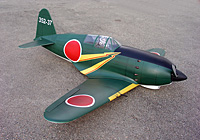
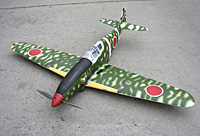
The Kawasaki Ki-61 Hien was a World War II fighter aircraft used by the Imperial Japanese Army Air Force.
The allied code name was "Tony", given by Allied pilots who initially thought it was a derivative of an Italian Macchi.
The Japanese Army designation was "Type 3 Fighter".
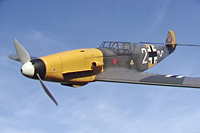
The design development was influenced by the design of the Messerschmitt Me 109 and Heinkel He 100,
the Ki-61 was the only Japanese fighter powered by a liquid-cooled engine.
The first prototype Ki-61 flew in December 1941 and first entered service in the spring of 1943 in the New Guinea campaign.
The first versions were armed with machine guns and the last versions had cannons in the wings
(German Mauser MG 151/ of 20 mm, later replaced with a cannon of local design: Type Ho-5 of 20 mm).
The aircraft was utilized in South and Southwest Pacific, Philippines, Southeast Asia, Okinawa, China, Manchuria and
Japanese Metropolitan defense against USAAF B-29s. Some were also used in Kamikaze missions toward the end of the conflict.
The Ki-61 was delivered to fifteen sentai (squadrons), state Major Chutais and other operational training units in the
Imperial Army Air Force.
The design process
To develop the model design I did extensive research on the Internet and found several good sources of
information, including drawings, photos and text. I always begin my design by either working with a good
three view and/or profile drawings. I also use images capture from UBIsoft's Pacific Fighters WWI
combat simulator. The models used in this simulator are know to be very accurate and detailed and provide
additional information critical in the development of an accurate flying model.
I imported these drawing into my CAD software (AutoCAD) and traced over the sketches making adjustments
for different views as I went. Once the three views were finished I scaled them to the desired wing span for this
model. CLICK HERE to view the
3-view drawing I developed for this model.
|